Quick Take
Cannabis oil is the most versatile infusion you can make. Use it anywhere a recipe calls for oil or substitute it for butter. It’s great for brownies, cookies, salad dressings, and more. Here’s how to make cannabis oil at home with MCT, coconut, or olive oil. You don’t need anything other than tools you probably already have in your kitchen.
published 6/30/26
Cannabis Oil is the Swiss Army Knife of Edibles
If cannabutter is the OG of cannabis infusions, cannabis oil is its flexible sibling. It works in everything butter does, including baked goods (like brownies), gummies, savory dishes, and salad dressings. If a recipe calls for oil, this cannabis oil will work in it. And unlike cannabutter, it’s naturally dairy-free and vegan, which means more people at the table get to enjoy it.
The other thing we love about cannabis oil? You have choices. MCT oil, coconut oil, and olive oil: each brings something different to the table, and we’ll walk you through all 3. (Spoiler: MCT is our top pick, and we’ve got a video to show you exactly why.)
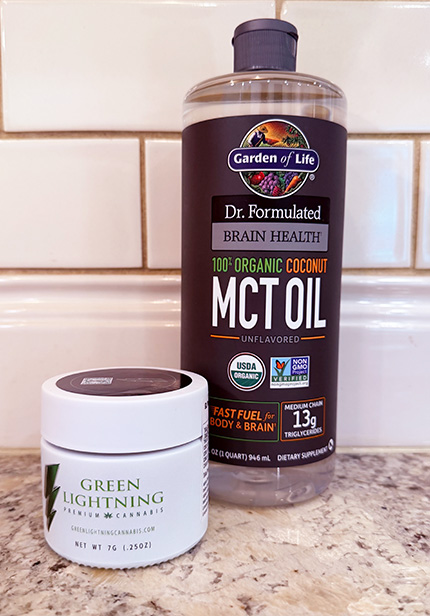 There’s also no special equipment required for any of the methods we outline here. You only need a few kitchen tools that you probably already have. We’ll walk you through 3 methods: a slow cooker canning jar water bath, a double boiler, and a stovetop water bath. Before we get started, we’ll tell you exactly what you need for each method.
One thing to note before you dive in: this recipe assumes that your flower has already been decarboxylated (e.g., decarbed). Decarbing your cannabis is a must. So, if you haven’t done that yet, start with the decarbing instructions in our soup-to-nuts cannabutter guide before coming back here. We’re begging you, please don’t skip this step. If you don’t properly decarb, you’ll be wasting tons of THC. And nobody wants that!
Which Oil Should You Use?
Cannabinoids are fat-soluble, which means that they latch onto fat better than anything else. The more saturated fat that a food has, the more efficiently it’ll carry those cannabinoids into your body. Here’s how the 3 main oil options compare.
MCT Oil
MCT oil is our top pick. It’s made from coconut or palm kernel oil and contains medium-chain fatty acids that your body absorbs super quickly, so it binds and absorbs cannabinoids more efficiently than other oils. It’s also the best option for preserving terpenes during infusion. It’s flavorless, stays liquid at room temperature, and has the longest shelf life of the oils we recommend. Plus, since it stays liquid and essentially flavorless, you don’t even have to make edibles with it. You can just put a little under your tongue as a tincture. Watch our video below to follow along step by step as we make it.
Keep Exploring Sublingual THC
- Sublingual THC: a fast, precise alternative to edibles
 Coconut Oil
 Coconut Oil
Coconut oil is solid at room temperature, which makes it a great butter substitute in baked goods. Its high saturated fat content still makes it a really efficient oil for extracting cannabinoids. Plus, it’s dairy-free. If you’re making cannabis brownies or cookies and want a buttery texture without the dairy, this is your go-to.
Olive Oil (Extra Virgin)
but it brings antioxidant properties and a rich flavor that works beautifully in savory applications. Just keep in mind that it’s the most perishable of the three.
A Quick Word on Choosing Your Flower
Before you get started, it’s worth thinking about the kind of high you’re going for. Do you want to be relaxed, comfortable, focused, social, or sleepy? Depending on what you’re going for, pick flower with cannabinoids that match your goals. For instance, a 1:1 THC to CBD strain can be great for bodily high that’s relaxing or comforting. For a more heady high to stay focused, try a strain that has mainly just THC. Or, if you want help getting or staying asleep, a 1:1:1 THC to CBD to CBN strain is your best bet. And if you want a deeper dive into strains and their effects, our strain guide has you covered.
Keep Exploring Cannabis Strains
- Cannabis Strain Guide: find the right flower for the high you want
What Kitchen Tools Do You Need?
 What Kitchen Tools Do You Need?
No specialty equipment required. Here’s what you’ll need regardless of which infusion method you choose:
- Slow cooker, stockpot, or double boiler (choose your method below)
- Candy thermometer
- 2 lidded airtight canning jars (must specifically be canning jars so they can take the heat)
- Fine mesh strainer
- Cheesecloth (grade 90)
- Rubber band
- Scissors
- Liquid measuring cup
- Spatula
- Baking sheet and parchment paper (for decarbing)
- Heavy kitchen towel
- Oven mitt
Ingredients
- 1 cup oil
- ¼ ounce decarboxylated cannabis, coarsely cut
A note on cutting your flower: for edibles, coarser is better. That’s why we use a scissors instead of a grinder to break up our cannabis for edibles. You want to taste the recipe, not the weed. The finer the flower, the more chlorophyll will leak into your oil, and chlorophyll is what will give your oil a bitter, grassy flavor. Finely ground cannabis is also harder to strain out of your oil when you’re done infusing.
3 Methods for Making Cannabis Oil
 3 Methods for Making Cannabis Oil
Method 1: Slow Cooker
Best for a hands-off approach with the lowest risk of overheating.
Ingredients (see exact amounts above)
- Oil
- Decarbed cannabis
Instructions
- Combine the oil and the decarbed cannabis in a canning jar. Seal the lid tightly and shake to combine.
- Place a folded kitchen towel in the bottom of the slow cooker and set the jar on top of it. Fill the slow cooker with warm water until it reaches at least the level of the oil inside the jar, adding more water to get as close to 1 inch above the oil line as possible without letting the jar float.
- Set the slow cooker to low and close the lid.
- Infuse for 4 hours, but you can leave it for up to 6 hours.
- Remove from the heat and strain. See the straining notes below for exactly how to strain. Straining is really important to get the best tasting oil.
Method 2: Double Boiler
 Method 2: Double Boiler
Best for those of us who have minimal equipment. When you’re making canna oil on stove top with a double boiler, you just need a sauce pan, a metal bowl, and you don’t even need a canning jar.
Ingredients (see exact amounts above)
- Oil
- Decarbed cannabis
Instructions
- Fill a saucepan with a few inches of water and bring it to a low simmer. Set a metal bowl on top that’s shallow enough not to touch the water.
- Combine the oil and the decarbed cannabis in the bowl. Clip the candy thermometer to the side of the bowl.
- Shoot for 185°F (85°C), but anywhere between 160°F and 200°F (71°C–93°C) is fine. Stir regularly. Slowly add more water as it boils off, and turn down the burner if the temperature creeps too high.
- Infuse for 4 hours.
- Remove from the heat and strain into a container. See the straining notes below for exactly how to strain. Straining is really important to get the best tasting oil.
Method 3: Stovetop Canning Jar Water Bath
 Method 3: Stovetop Canning Jar Water Bath
Best for those of us who don’t have a slow cooker but don’t want to have to watch a pot that closely.
Ingredients (see exact amounts above)
- Oil
- Decarbed cannabis
Instructions
- Combine the oil and the decarbed cannabis in a canning jar. Seal tightly and shake to combine.
- Place a folded towel in the bottom of a pot and set the jar on top. Fill the pot with warm water until it reaches at least the level of the oil inside the jar, adding more water to get as close to 1 inch above the oil line as possible without letting the jar float. Clip the candy thermometer to the side of the pot.
- Shoot for 185°F (85°C), but anywhere between 160°F and 200°F (71°C–93°C) is fine. Slowly add more water as it boils off, and turn down the burner if the temperature creeps too high.
- Infuse for 4 hours.
- Remove from the heat and strain into the second canning jar. See the straining notes below for exactly how to strain. Straining is really important to get the best tasting oil.
The Right Way to Strain Your Oil
- Once your infusion is done, remove it from the heat with an oven mitt and let it sit for 5 to 10 minutes. This gives the plant matter time to settle to the bottom, right where you want it.
- While you wait, prep your storage container. Saturate the part of the cheesecloth that’ll cover the container’s opening with some uninfused oil. Only use enough oil to just dampen it, not so it’s dripping. Doing this prefills the fibers with uninfused oil. So, it keeps the cheesecloth from soaking up much of your THC oil.
- Secure a single layer of the dampened cheesecloth over the container opening with a rubber band or kitchen twine. Rather than pulling it taut, leave enough slack so that the cloth sags into a bowl shape. That way the strainer can rest on top of it, and the oil will pool in the center to drip down into your container.
- When your infusion has settled, if you’re using a canning jar, open it carefully. It’ll release hot steam, so use your oven mitt to keep from burn yourself.
- Pour the infusion slowly into the strainer in a thin, steady stream. The strainer will catch the big chunks of plant matter, and the cheesecloth will filter out the tiny bits.
- If the flow slows, wait until the oil stops backing up. Don’t give into the impulse to squeeze or press the solids in the strainer. Squeezing forces chlorophyll, the green stuff, into your oil. It’s the chlorophyll that will make your oil taste like weed. And you don’t want that flavor in your edibles.
- Instead, tilt the strainer side to side to let the oil get through fresh mesh. if you need to, you can remove some of the solids with a spatula. When the pour slows to a drip, let it sit for at least 5 minutes so gravity finishes the job for you.
 some uninfused oil. Only use enough oil to just dampen it, not so it’s dripping. Doing this prefills the fibers with uninfused oil. So, it keeps the cheesecloth from soaking up much of your THC oil.
Storage
If possible, we recommend storing your oil in a canning jar. Canning jars are airtight, leak-resistant, and won’t leach anything into your oil the way that plastic can. Also, keep your cannabis oil away from light and heat, since both degrade THC and other cannabinoids.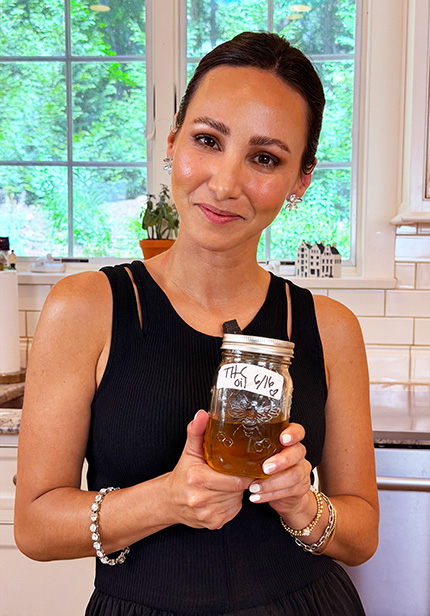
In the fridge, your oil will keep for about 2 months. In the freezer, it’ll keep for about 6 months.
Just make sure you label your container clearly. Like, REALLY clearly. The last thing you want is for someone to grab it by accident and get a surprise they weren’t bargaining for.
Dosing Your Cannabis Oil
Figuring out how strong your homemade cannabis oil ends up being can be tricky. That’s because, without lab testing, you can never tell precisely how much of the THC ended up in your infusion. That’s not just a you thing. Extraction never gets to 100% even for professionals. For home infusions, the average extraction rate can be anywhere from 60-80%. Considering that, here’s a formula that will give you a reasonable estimate with an average 70% rate:
(milligrams of THC in your flower × 0.7) ÷ total oil volume in mililiters = THC mg per ml
But, if you’re like most of our team, you like your weed without any complicated math. That’s why we built a dosing calculator for you that’s complete with the average extraction rate above. Just plug in the details about your flower and oil along with the servings in the recipe you’re making, click a button, and get the exact amount you of infused oil you need to get servings that are as precisely dosed as you can get with homemade edibles.
Explore Microdosing
- Microdosing THC: everything you need to know
That brings us to how many milligrams of THC you should put in your servings. Obviously, if you know your tolerance well, you can make your edibles as strong as you want. But, a standard starting dose is 2.5-5mg of THC per serving. Always start low and wait at least 2 hours to see how you feel before eating more because edibles can hit significantly differently for everyone. How much is right for you depends a lot on your specific body chemistry, your weight, and even what you’ve eaten that day.
If your infusion turns out more potent than you wanted, there’s a super easy fix. Just dilute it by combining your cannabis oil with plain oil that’s the same type you used for your infusion.
Get a Precise Dose Every Time with Our Calculator
- Edible Dosing Calculator: nail your dose every time
Now the Fun Part: Everything Else About Cannabis Edibles
Now that your oil’s made, here’s where to go next:
- The Complete Weed Edibles Guide: everything you need to know about dosing, timing, and getting edibles right
- Edibles Dosing Calculator: figure out exactly how much oil to use in your next recipe
- Cannabis Brownie Recipe: our most-loved edibles recipe
- Cannabis Gummy Recipe: for when you want something portable and precise
- How to Make Cannabutter: the buttery counterpart to this guide plus exactly how to decarb
Responsible Use
For legal adults 21+ only. Start low and go slow. Effects from edibles may take up to 4 hours to fully manifest—do not redose before allowing sufficient time. Do not drive or operate machinery after consuming cannabis or hemp-derived THC products. Keep out of reach of children and pets.